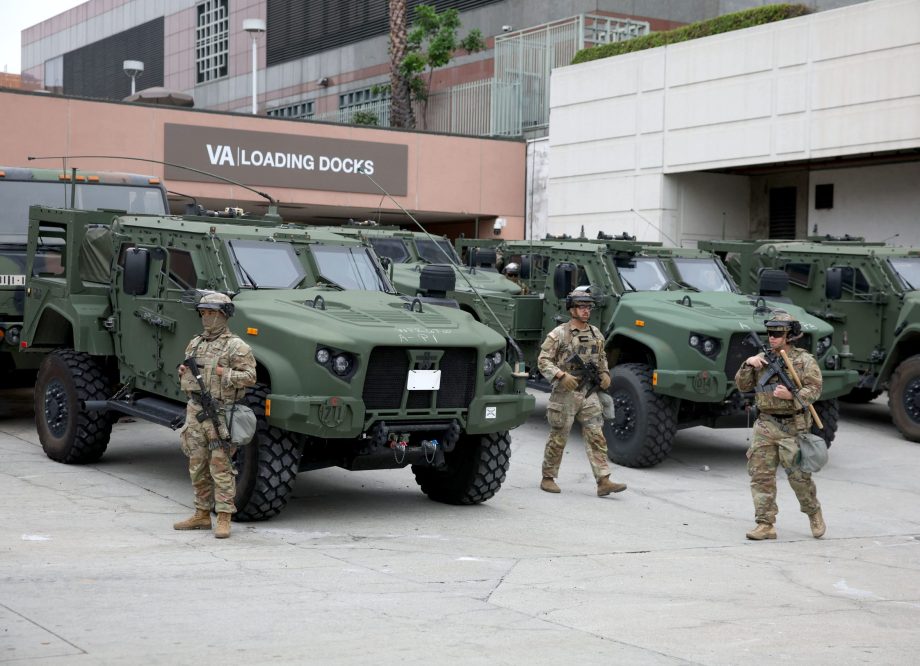
This week has been a long month. As I imagine is true of most households right now, we’ve been keeping up with the events in Los Angeles following the ICE raids that have nabbed people from their communities in ways designed to be disruptive to the community and instill fear of reprisals if people resist this inhumane mandate.
In some ways, the scene is distinctly a product of this moment. We’re living in a time of uncertainty and civil disruption caused by an authoritarian push from the White House. California’s National Guard has been deployed against the wishes of the governor with a flimsy legal excuse. This administration ran on and was elected to crack down on illegal immigration in the cruelest ways possible.
Moreover, this particular moment is one in which many of us are discerning our own best course of action. We know by now, or should, that reactivity in the face of a regime whose chief tactic is to flood the zone with as much bullshit as possible is too exhausting to maintain for any length of time. This is an exercise in causing as much pain as possible. The intent is to instill fear in a populace already exhausted by an increasingly brutal economic reality.
This is also just another day in the life of America.
Little Red Light on the Highway
For a nation founded upon freedom of assembly and seizing liberty by force, we sure do get antsy when folks imitate our Founders too closely. I’m not saying riots are good. I’m also not saying that destroying property and attacking public officials is somehow a good practice.
I am saying that a riot is the last bastion of free speech for a people whose liberty is under assault. I read somewhere that one reason Rev. King’s peaceful resistance was so effective is that Malcolm X’s by any means necessary was always present as a second viable option. I don’t know that I particularly believe that, but I do resonate with the idea that the perceived urgency for justice is proportional to the discomfort folks in authority feel.
I’m also saying that American culture frequently has a fight or fight response until the pain of staying the same far outweighs the pain of change, unless it’s more convenient. History bears this out.
Big Green Light on the Speedway
The first time a president federalized the National Guard was when George Washington did so to quell the Whiskey Rebellion in Pennsylvania. Farmers and distillers didn’t want the government mucking around in their business through taxation, even with representation. This is a scant seventeen years after the American Revolution, whose beginning is frequently attributed to the Boston Tea Party. While rebelling against taxation should therefore be one of the most American things ever, John Adams also deployed the guard when John Fries roused the rabble to revolt against direct taxation of land and property, leading a revolt aptly named Fries’ Rebellion.
Further reading tells me that federalizing the National Guard or other similar military forces was used infrequently until the Civil Rights Era, which, in considering America’s other longest-standing pastime, enslaving and oppressing black and brown folks, makes perfect sense.
When you get right down to it, we do a lot more quelling unrest caused by people demanding liberty than we do pursuing freedom as a nation. So while cruel, TACOMango’s deployment of the National Guard is far from unusual.
It’s more surprising to me to learn the Marines have been used on several occasions to quell rebellions. In 1863, late in the Civil War, New Yorkers rioted against the first military draft of civilians so hard that Lincoln eventually sent the Marines, some of whom were fresh from the Battle of Gettysburg. This remains the largest rebellion in US history, according to this article.
In 1932, another rebellion, Congress promised financial aid to help WW I veterans and their families get through the Great Depression, $1 per day of service up to a maximum of $500These upstart veterans said their families needed a lump sum to alleviate the dire need they and their families had right then. So Hoover did what any sane man would do.
He sent the Marines to squelch freedom-hating World War I veterans.
Now this wasn’t just some group of hippies. This was a Bonus Army of around 20,000 battle-hardened veterans and their families. They marched on Washington with guns blazing, determined to get their promised relief up front and in full one way or another! None other than General MacArthur himself led the US troops to engage the violent mob to defend the nation’s capital from the onslaught of half-crazed military veterans determined to stand their ground.
At the end of the day, Congress, moved by their heroism, felt a deep-seated pity stemming from their profound respect for veterans, and finally relented, granting them the promised help.
The Bonus Army was a group of starving veterans and their families, many dressed in faded uniforms and rags. They came to beg Congress to help them by giving them their up-to-$500 bonus (hence the name) in a lump sum so they could survive. Congress refused. According to the link above, about a quarter of them accepted a free ride home offered by Congress when they refused, but the rest stayed because many of them had nowhere else to go.
The advancing troops were overseen, but not led, by General MacArthur. The charge of cavalry and five tanks stormed forward, but not toward a military force prepared to fight. It was General George S. Patton, whose reputation for cruel punishment and soldier-slapping was well-known, who led the troops himself on horseback toward a ragged encampment of stranded veterans. Some of them saw the advancing troops and tried to defend themselves with clubs, bricks, iron bars, and other makeshift weapons, but they were no match for the American war machine. Most of them fled, knowing they were outmatched.
All of this puts into perspective how willing we are to green light siccing our troops on our own citizens, something that feels like it should only be able to happen in backwater nations with Tin Men who feel powerful, preying upon the weak.
Such is the Trump regime.
The military was also used to police the general population several times during the Civil Rights Era, and finally in 1967 use of the military to quell riots across the nation following the assassination of Rev. King.
It’s a Shame They Couldn’t Be More Copacetic
Our history is checkered with government violence against our own population, but other than early rebellions against military conscription and taxation, white violence against black and brown people is never considered a real threat, despite the fact that it takes Wikipedia around a full fifteen printed pages to record the timeline of major incidences of mass racial violence against black, brown, and indigenous people during our nation’s history.
And again, I should not have been surprised to learn that this isn’t even the first time the Marines have been deployed to “settle things” in Los Angeles. The first was in 1992, following the acquittal of the officers who brutally beat Rodney King. I don’t know whether it’s to my credit or not that I was surprised, but there you have it.
Each time this happens, the brutality of our war machine’s deployment is blamed on “people who…” The song remains depressingly the same, and even the verses rhyme.
They shouldn’t be out there breaking things.
They should have just complied with law enforcement.
They shouldn’t have run.
They shouldn’t have been selling loosies.
They shouldn’t have been wearing a hoodie.
We’re so quick to decry these incidences of violence because we’re utterly incapable of looking past the gory allure of telling folks why they shouldn’t do what’s been done to them. Generation after generation, we fail the first test of human decency when we fail to look ourselves in the mirror with integrity to consider, maybe it’s us. Maybe we’re the problem.
Maybe there’s something to the idea that we can’t just step out of the bloody clothes of our founding and into a new world without — finally — owning our nation’s violent present, and taking some real time to consider our own complicity.
When I was in South Carolina, I think talking about this was just part of our DNA on account of our peculiar relationship to chattel slavery. I was shocked when a few black friends told me, upon hearing we were moving to Boston, “Boston’s the most racist place I’ve ever been!” There’s truth in this, considering the famous deeply held feelings about Irish folks and whatnot. And Massachusetts isn’t immune to our own racial unrest. In 1984, a riot broke out in Lawrence, MA, between white and Hispanic people that included Molotov cocktails and destroyed buildings.
The difference between South Carolina and Massachusetts isn’t that one is more racist than the other, it’s the willingness to look ourselves in the mirror without flinching.
I Don’t Wanna Be Mean About It
As we approach the tenth anniversary of the martyrdom of the Charleston 9, which is closely followed by the tenth anniversary of this website, I’m struck by the differences in how the North and South contend with racism.
When I arrived here, despite what my black friends told me (irony intended), I was shocked to see that talking about racism makes people so frightened to offend anyone that it’s challenging to get a conversation going, even in church, unless there’s something that boils over into a larger conflict.
Part of what tells me my friends are correct is that though redlining may have nominally ended, the deep segregation of many towns remains. It’s no longer a matter of reality schemes perpetrated in hushed voices, but institutionally enshrined in zoning laws as concern for our property values. It came as no shock that all the bad neighborhoods just “happened” to be populated by persons of color. Our systems of racism are often obscured by well-intentioned efforts like (necessary) busing programs. We rightly feel some kind of way, more precisely a mix of guilt and resignation, that our housing policies have “unfortunately” priced out many historically marginalized communities from neighborhoods where a strong tax base funds excellent schools. We know that it’s tragically unjust that, even now, access to quality education remains largely exclusive to the wealthy, or those willing to make significant sacrifices, like being bused.
I used to be frustrated by this.
No, that’s a lie.
This used to make me angry as hell.
I’ve had to learn a deeply intentional patience with the fact that people can only be where they are in their personal pursuits of equity and justice, even when they seem unwilling to consider it.
There’s something in the breaking of this anger that deepened my resolve to stand with people marginalized by our systems of oppression. I learned long ago to listen to the voices whose literal lives depend on immediate justice. I also learned from my black friends in the wake of Charleston that going around angry with white folks about their unreflected racism does no one any good. The good we can do is best done in partnership with the people most vulnerable to our whims.
I Don’t Have One Good Thing to Say
Dwelling in this peculiarly generic Moment in time, we have the latitude to choose a great many things.
When I say we, I mean we white people.
I say we can choose, but it isn’t whether or not we should be doing justice. What we choose is whether to embrace our humanity and accept our obligations to marginalized people, or to embrace our complicity by ignoring what’s right in front of our faces.
We white folks have an obligation to be about this work. If you’re the religious sort who’s Christian, I tell you as a pastor that you have a sacred obligation to do something that actively furthers the cause of freedom. I know this resonates in New England, because I see the passionate declarations of No kings then, no kings now!, among other visible reminders of our values — like Sudbury Pride signs!
I think the real difference I experience here is that New Englanders seem to live in our heads much more than our hearts. While we still have to be careful about the ready, fire, aim approach endemic to supremacist culture, our unique struggle is branching out beyond book study inactivism to do the work that saves literal lives. I sincerely appreciate what it takes to step into uncomfortable action, especially when we feel we aren’t ready, but this is a moment when our discomfort is needed — and expected.
That said, we do need more discipline than the act of simply following our feelings.
If we follow our feelings, we too easily fall into the rage trap. Raging against racist powers and principalities without considering the impact on those who are more vulnerable is, in some very real ways, joining the very forces we oppose because our distinct voice is easily dismissed if our main form of activism is virtue signalling and doomscrolling. More, because we do have a voice that can be heard by a system designed to our benefit, we’re obligated to work within it, careful not to make life harder for those we hope to help with unreflective behavior.
If we who live comfortably within the culture join in rioting, we aren’t defending the people in our homes or the businesses that serve our neighborhoods; we’re trespassing. We simply are not entitled to join in the release of anger, fear, and oppression expressed by oppressed populations, especially in predominantly black and brown communities because we have access to the conventional means of Speech denied those who must resort to this type of deafening speech to preserve what there is of liberty and dignity.
We can engage in the work of diminishing the danger we pose. More cerebral tasks, like book studies, are worthwhile as long as they aren’t all we do. We have bandwidth for them because our lives aren’t threatened by the Machine. It’s incumbent upon us to stand in our integrity by doing what we learn and discuss, rather than committing to the causes of equity and justice as endless ego-driven exercises of academic inactivism.
Not all worthy resistance is accomplished by protestors or organizers. Those of us whose role is to make noise need the book study crowd to use their skills to draft legislation, engage in advocacy by tending to the details that I never could, and challenging the racist ideation endemic to our culture.
One Will Do
It’s intimidating to think of this all at once. There really is an insurmountable volume of work we need to do, yet this isn’t the work of one, but of many. For this reason, it is doable.
One will do in the efforts of reformation we undertake to lessen our complicity. One will do when we stand in our discomfort as we clumsily tell our friends, coworkers, or family members that we aren’t accustomed to keeping company with people who degrade another person’s humanity for any reason. One will do when we bear witness to the grinding wheels of the Machine in action. When we encounter something bigger than what we can stop, we can document, record, and share what we see — an ICE raid, a traffic stop, a line of conversation at a town meeting, or our bosses speaking and acting in ways that perpetuate the ideologies of prejudice.
You will do when you use your voice in ways that risk your comfort, and it’s here we encounter the most significant impediment to a just and equitable world. We’re wired to avoid doing things that bring discomfort. Typically, I’d insert a joke here about how you can look at me and see the lengths to which I’ll go to avoid discomfort as a pattern throughout my life because you can only achieve this kind of shape through years of neglect, but I’ll refrain from such low-hanging jokes. Avoiding jokes about my willpower being directly proportional to how close we are to dinner is imperative, because we’re all called to do the work where one is enough.
Finally, if any of the 3.687 of you reading this take anything away, take this.
No one expects you to do it all.
That said, I hope you accept this invitation to take the time to discern your part. If you do this, you have my gratitude and encouragement, but more, you have friends waiting to greet you at the door.
 Love Sees Color